
The BOP network was designed to stop men with wire-cutters. It’s now facing drones that cost less than the generator inside the compound. India’s response? Build more compounds.
The Kharkola Verdict
On May 10, 2025, during Operation Sindoor, Border Outpost Kharkola in the RS Pura sector of Jammu came under intense cross-border mortar shelling compounded by coordinated drone attacks. Sub-Inspector Mohd Imteyaj and Constable Deepak Chingakham of the BSF were killed — both later awarded the Vir Chakra posthumously. Multiple others were critically wounded. The drones involved cost a few thousand dollars each to build and deploy. The outpost they helped neutralize cost the Indian state upwards of $4.8 million.
That single strike was not an anomaly. It was a verdict — delivered cheaply, precisely, and irreversibly — on India’s entire border architecture.
India operates the world’s largest border-guarding force yet remains helpless against asymmetric threats. The Border Security Force fields roughly 270,000 personnel across 193 battalions, manning over 1,800 Border Outposts along the Pakistan and Bangladesh frontiers, with 509 more sanctioned and under construction. These are permanent, fortified, self-contained compounds — each designed to include barrack facilities, a kitchen, a dining hall, a garage, a generator room, a toilet block, an administrative block, a wireless room, a weapons room, and six cemented bunkers for protection — placed at regular intervals across 7,400 kilometers of land border. Each one is a small fort. Each one is visible from space. Each one is a fixed, geolocated coordinate that any adversary with a commercial satellite subscription can pre-plot for strike years in advance.
The thesis of this article is straightforward, and I think the evidence is now conclusive: India’s BOP network, in its current form, is not a defensive asset in wartime. It is a liability — the single greatest source of concentrated, predictable, and affordable-to-inflict mass casualties available to any adversary willing to invest in cheap precision munitions. India’s response to the May 2025 crisis has been to harden, upgrade, and build more of these positions - a primitive reaction revealing institutional decay. That response deepens the problem. Absent a fundamental doctrinal shift away from static manning, the next India-Pakistan escalation will produce BOP casualties at a scale that forces the rethink India should be undertaking now.
The Maginot Math — What India Has Built
The numbers are staggering in their scale and specificity.
Along the India-Pakistan border alone — 3,323 kilometers of it — the BSF operates between 675 and 736 BOPs, with 126 new composite outposts sanctioned. Along the India-Bangladesh border, the count is higher: approximately 1,096 operational posts, with 383 more composite BOPs approved. Combined, the network stands at roughly 1,800 operational positions moving toward 2,200 or more. This covers only BSF-managed borders. The ITBP (China), SSB (Nepal and Bhutan), and Assam Rifles (Myanmar) maintain their own networks, pushing the all-India total significantly higher.
The cost per unit varies by terrain and specification. Floating BOPs deployed in the Sundarbans mangrove — bullet-proof front sections, four patrol boats capable of 29 knots, a month’s fuel and food — run to $4.5 million each. A composite BOP with associated infrastructure in Kathua, Jammu & Kashmir — including eight women-friendly barracks, high-mast lights, and a G+1 tower — was budgeted at $5.6 million for the entire site. Standard land posts come in lower, but still in the range of several million dollars. In 2018, the government separately sanctioned $49.5 million for the construction of 14,460 individual and community bunkers along the Line of Control and International Border to protect border residents — a parallel investment that further illustrates the scale of fixed fortification spending.
Aggregated across the Border Infrastructure and Management scheme for 2021–2026, approved at $1.55 billion, and a broader Ministry of Home Affairs capital outlay that surged 84% from 2024–25 to $2.53 billion in 2026–27, the total investment in fixed border infrastructure is measured in the tens of billions.
The satellite imagery tells the story more efficiently than any budget line. Each BOP appears as a walled rectangular compound — typically 50 to 100 meters on a side — sitting in open terrain. In the Thar desert sectors, they are pale squares against featureless sand, connected by single access roads, with zero natural concealment. In the Rann of Kutch, they sit on raised platforms surrounded by salt flats and seasonal water — isolated, elevated, and maximally exposed. Along the Punjab agricultural sectors, they are neat enclosures abutting farmland, identifiable by their symmetry against the irregular patchwork of fields. In every environment, the pattern is the same: a regular geometric shape, distinct from its surroundings, connected to infrastructure, and radiating electromagnetic emissions from generators, radios, and radar. They might as well be painted with targeting crosses.
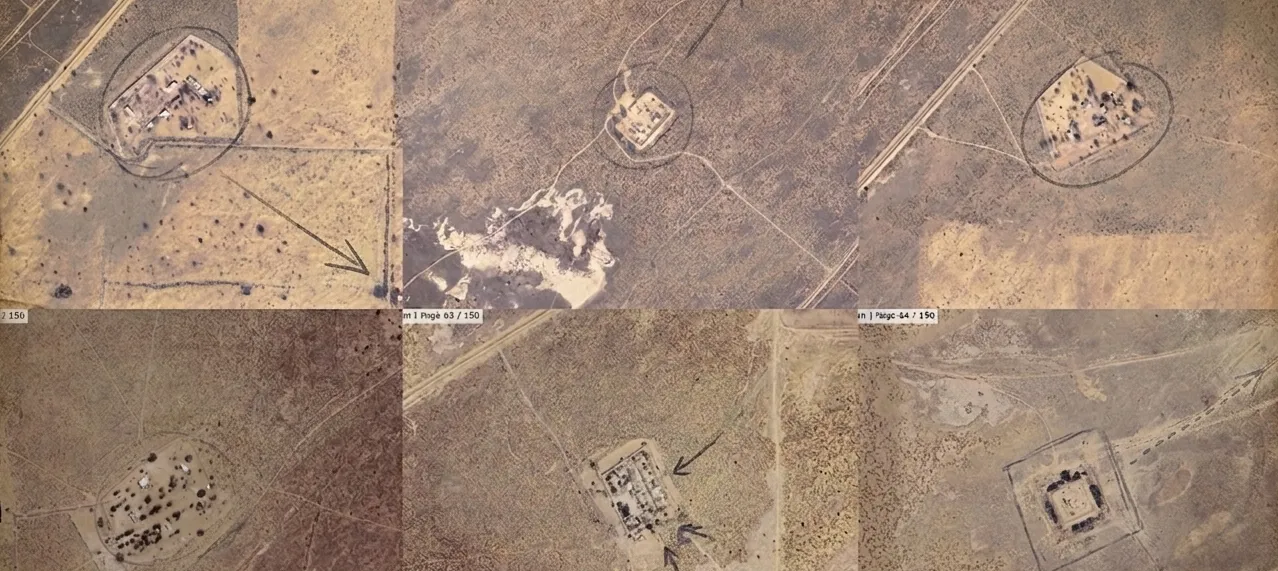
But the satellite imagery also reveals something the budget figures conceal: the network is not uniform. BOP quality varies dramatically across sectors, and in many areas the infrastructure is visibly degraded or barely functional. In the Sir Creek and Harami Nala sectors of Gujarat — a 96-kilometer tidal estuary where saltwater tidal waves cycle every four hours — no permanent structures existed at all until 2023, when eight vertical bunkers were sanctioned at $6 million. The high salt content corrodes anything made of metal. BSF personnel patrol barefoot because boots cannot be worn in the swamp. A 75-kilometer water pipeline from Dharamshala to Vighokot suffers frequent leakage due to salt corrosion, and a borewell drilled to 715 feet at Bhediya Bet BOP yielded water with 4,300 TDS — unusable for drinking. In December 2025, a floating border outpost deployed for Sir Creek surveillance was found still sitting at Mandvi Port for repairs six months after being pulled from service, its contractor penalized for substandard workmanship. Its absence left a gap in uninterrupted maritime surveillance along Kutch’s border.
The inland picture is no better. In September 2025, Punjab experienced its worst flooding since 1988, and the Sutlej at Hussainiwala surged to 225,420 cusecs. Over 110 kilometers of border fence was damaged — submerged, uprooted, or tilted — and approximately 90 BSF posts were inundated: 65 to 67 in Punjab and 20 in Jammu. In Ferozepur and Fazilka, two outposts were fully submerged and four more surrounded by floodwaters. One BSF jawan drowned. The Parliamentary Standing Committee on Home Affairs found in 2016 that jawans were working 16 to 18 hour days due to manpower shortages, fencing progress had crawled to just 21 kilometers in 17 months in some sectors, and desert fencing in Rajasthan’s Thar region proved ineffective because shifting sand dunes simply buried the barriers. As of January 2023, 83,127 posts remained vacant across CAPFs and Assam Rifles against a sanctioned strength of over one million. The original 509 composite BOP target was quietly reduced to 422 in 2016, and along the India-Bangladesh border only 97 of 326 targeted outposts had been completed by year’s end.
The result is a network that is neither uniformly strong nor uniformly weak — it is unevenly degraded in ways that any adversary can map. The well-resourced showcase posts at Nadabet or the hardened compounds in Jammu attract the cameras; the corroding, understaffed, flood-damaged positions in the Rann, the Sir Creek, and the Punjab floodplains do not. But those degraded posts occupy the same targeting database as the flagship ones. An adversary planning a coordinated strike doesn’t need to overcome India’s best outposts — it needs to identify the weakest ones, and the satellite imagery makes that straightforward.
The garrison exposure matches the infrastructure exposure. The BSF does not publish per-post troop strength, but working from aggregate figures — 270,000 total personnel across approximately 1,800 BOPs, accounting for headquarters, training, reserves, and internal security assignments — the estimated garrison per standard BOP is 30 to 50 personnel. At any given time, an estimated 50,000 to 65,000 BSF personnel are stationed at fixed, known, pre-mapped positions along the border. That is not a defensive deployment. It is a pre-loaded casualty list.
One Drone, Two Dead, One Proof of Concept
The Kharkola attack needs to be understood not as a tragic incident but as a scalable demonstration.
A coordinated assault of mortar shelling and drone strikes hit a fixed compound whose coordinates had been known for years. Two BSF personnel killed, multiple critically wounded, one post functionally neutralized. Drones of the kind used cost between $1,200 and $6,000 each to assemble. The entire sequence probably lasted minutes. The cost ratio between the weapons deployed and the infrastructure they destroyed is radically asymmetric.
Now multiply. There are over 700 BOPs on the Pakistan border. Imagine a coordinated first-strike package of 200 drones — each costing a few thousand dollars, total investment under $2.4 million — launched simultaneously at dawn during a fog event in the Punjab-Rajasthan sector. Each drone is targeting a compound whose coordinates, layout, garrison strength, and daily schedule are known from satellite imagery and years of basic intelligence collection. Even at a 50% success rate — accounting for mechanical failures, navigation errors, and whatever counter-drone systems happen to be operational at specific posts — that is 100 BOPs hit in minutes. At 30–50 personnel per post, the casualty count is in the low thousands before a single Indian Army unit has been mobilized.
This is not speculation. This is the math that the Ukraine conflict has taught every military planner on earth. Static positions die first and fastest in a drone-saturated battlespace. The Ukrainian army learned this at enormous cost across the Donbas, where fortified positions that had held for years became death traps once cheap FPV drones reached mass deployment. The lesson was absorbed by every military that was paying attention — including, it must be assumed, Pakistan’s.
The BSF claims to have destroyed 118 Pakistani forward positions during the May 2025 operations — 76 Rangers border outposts, 42 Forward Defense Locations, and 3 terror launchpads. If accurate, this proves the vulnerability thesis from both directions: Pakistan’s fixed posts were just as exposed, and the BSF used mortar fire and surveillance targeting from its own BOPs to strike them. The mutual vulnerability is the point. In a war between two forces manning fixed positions within artillery and drone range of each other, both sides lose their forward infrastructure in the opening hours. The difference is that India has invested orders of magnitude more in its fixed positions than Pakistan has, which means India has more to lose per post destroyed, and the cost-exchange ratio favors the attacker.
Five Vulnerabilities, One Compounding System
The BOP network’s critical weakness is not any single flaw. It is the interaction between all of them simultaneously.
Start with the targeting problem. Every BOP is a permanent, geolocated structure on commercial satellite imagery. But even if an adversary lost satellite access, the posts would still be findable: each one operates generators, radios, radar, and increasingly counter-drone electronics, creating an electromagnetic signature that functions as a targeting beacon. In degraded conditions — fog, dust, darkness — where visual and satellite targeting fails, the electromagnetic footprint remains. The posts are visible in every domain.
Layer on the routine problem. BOPs operate on fixed schedules: patrol timings, shift rotations, resupply days, meal times. Weeks of basic signals intelligence or even direct observation can map these rhythms precisely. An adversary can time strikes to shift handovers — when personnel are clustered during changeover — or resupply windows — when vehicles are exposed outside the compound — to maximize casualties per munition.
Now add the supply chain problem. Many remote posts depend on single access roads. In the Thar desert, the Rann of Kutch, the Punjab floodplains, and the Sundarbans, cutting a single road or interdicting a single convoy functionally neutralizes a BOP without a direct strike. A 72-hour logistics disruption is sufficient to degrade combat effectiveness at an isolated post. An adversary doesn’t even need to hit the compound — just the road leading to it.
The communications problem compounds all of the above. BOPs rely on wireless RF links and, in upgraded sectors, fiber-optic connections. A coordinated electronic warfare attack — RF jamming plus physical cutting of fiber — could blind dozens of posts simultaneously. There is no publicly documented evidence of mesh-redundant communication architecture. Without communications, a post cannot call for reinforcement, coordinate with adjacent positions, or report what is happening. Each BOP becomes an isolated target.
And then the dispersal problem locks the casualties in. When a BOP comes under attack, there is no evident doctrine for rapid dispersal and reconstitution at pre-planned rally points. Personnel are inside a walled compound — the same compound the adversary is targeting. If the walls are hit, the people inside are casualties. This is the opposite of modern infantry doctrine, which emphasizes dispersal, mobility, and reconstitution after contact. BOPs concentrate troops into kill zones by design. The walls that protect against small-arms infiltration become the perimeter of a blast radius under drone and artillery assault.
Each of these vulnerabilities is serious individually. Together, they compound into a system where the failure of any one layer accelerates the failure of the others. Jammed communications prevent the post from calling for help. Disrupted supply roads prevent reinforcement from arriving. Fixed coordinates guide the strike. Predictable routines time it. Concentrated personnel maximize the damage. No dispersal doctrine prevents escape. The system doesn’t degrade gracefully. It fails catastrophically.
And the terrain makes it worse. The BOP model applies a largely uniform operational concept across radically different environments. Desert-sector posts sit in open terrain with zero concealment — maximally exposed to aerial strike. Riverine posts in Punjab and the Sundarbans face isolation by deliberate flooding or monsoon-timed water release, which can cut road access to entire clusters of BOPs simultaneously. Agricultural-sector posts along Punjab face the fastest escalation timelines, as they sit closest to Pakistan’s own forward military deployments. A single doctrinal framework stretched across all of these terrains is itself a vulnerability — one-size-fits-all defense in an environment that demands terrain-specific adaptation.
The Institutional Inertia Problem
In 2023, India sanctioned 509 new composite BOPs. The same year, the entire world was watching static positions get obliterated in Ukraine by cheap drones. The dissonance is revealing.
The explanation is institutional, not strategic. The BSF’s identity, budget authority, and organizational structure are built around the BOP. It is the unit of deployment, the unit of promotion, the unit of infrastructure spending. A BSF officer’s career is measured in posts commanded. The construction of new BOPs generates procurement contracts, engineering projects, and political announcements — the Home Minister inaugurating a new outpost on the border is a reliable media cycle. The entire institutional ecosystem incentivizes more fixed infrastructure, not less.
To be fair, India did begin adapting after May 2025. The BSF is raising a dedicated drone squadron, based at select posts along the Pakistan border, equipped with reconnaissance and attack UAVs operated from a control room at Western Command in Chandigarh. A Drone Warfare School was established at the BSF Academy in Gwalior in August 2025 — the first institution in India dedicated to drone warfare training. BOP hardening is underway: reinforced bunker roofs, alloy-sheet walls, counter-drone systems at the most vulnerable positions. DRDO’s D4S anti-drone system — integrating X-band radar detection, RF and GNSS jamming, and a laser-based directed energy weapon for hard-kill — is being deployed at border locations.
These are real steps. They are also incremental patches on a structurally flawed concept. The D4S system faces a pure scaling problem: there are over 700 posts on the Pakistan border alone. Equipping, maintaining, and keeping counter-drone systems operational at every post requires sustained technical manpower and budget that the BSF does not currently possess. The likely outcome is selective deployment at high-priority positions, which creates a known map of unprotected posts for any adversary with basic intelligence. The drone squadron adds offensive capability but does not solve the defensive problem of 1,800 fixed compounds exposed to simultaneous first strike.
The hardened bunkers are the most telling response. Reinforcing the walls of a building whose coordinates are publicly known, whose electromagnetic signature can be detected from kilometers away, and whose garrison follows a predictable schedule is an investment in surviving a hit — not in avoiding one. It accepts the premise that posts will be struck and tries to reduce casualties per strike, rather than questioning whether concentrating personnel in fixed positions is the right approach at all.
The Handover That Never Happens in Time
Indian doctrine holds that the BSF withdraws and the Indian Army assumes control of border positions during wartime. In theory, this means the BOP network only needs to survive long enough for professional military forces to take over.
In practice, the May 2025 conflict demonstrated that this handover cannot execute when escalation is rapid. The Pahalgam attack occurred on April 22. Operation Sindoor launched on May 7. Between the trigger event and the kinetic phase, there were fifteen days — and even that was not enough for a clean BSF-to-Army transition across the entire border. BSF personnel were still in position when Pakistani strikes arrived. The force occupying the most dangerous positions during the most dangerous phase of the conflict was the force least equipped to survive it.
This is not a training gap that can be closed with better preparation. BSF is a paramilitary border-guarding force. Its personnel are trained for policing tasks: anti-infiltration patrols, anti-smuggling operations, checkpoint management. They are not trained or equipped for sustained combat under drone assault, artillery bombardment, and electronic warfare. Asking BSF jawans to hold fortified positions under conditions that would challenge regular infantry is not a doctrinal plan — it is a structural failure dressed up as procedure.
The problem is circular. The BOP network exists because the BSF exists to man it. The BSF’s personnel are paramilitary because the BOPs are considered peacetime policing assets. But in war, those peacetime assets become frontline positions, and the peacetime force becomes frontline troops by default — because the handover to the Army cannot execute faster than the adversary can escalate.
Any future India-Pakistan escalation triggered by a terrorist attack — the most likely trigger — will reproduce this dynamic. The political pressure to respond quickly will compress the timeline between provocation and military action. The BSF-to-Army handover, which requires deliberate repositioning of units, resupply of Army-standard equipment, and physical movement of personnel, will fall behind the operational tempo. And BSF jawans will again find themselves in combat positions they were never designed to hold.
Counter-argument: The Peacetime Case Is Real
The strongest objection to this analysis is that BOPs were never designed for wartime and judging them by wartime performance is a category error.
This objection has genuine force. In peacetime — which is, by definition, the dominant condition — the BOP network provides real and irreplaceable value. It delivers 24/7 surveillance across thousands of kilometers of border that would otherwise be completely unwatched. The BSF’s anti-infiltration and anti-smuggling operations depend on the physical presence of personnel at regular intervals. Without BOPs, India would have zero situational awareness across vast stretches of the Thar desert, the Rann of Kutch, the Sundarbans mangroves, and the Punjab floodplains. The network’s deterrent effect on low-intensity cross-border activity — smuggling, narcotics, small-arms trafficking, and infiltration by non-state actors — is significant and well-documented.
Furthermore, network resilience should not be dismissed. Even if a first strike neutralized 30% of BOPs, the remaining 70% would still provide communication relay, observation, and staging capability. Destroying all 700+ posts on the Pakistan border simultaneously would require a coordinated operation of a scale and intensity that would itself provide strategic warning.
These points are valid. But they do not address the core problem.
Peacetime utility does not justify wartime architecture. India does not build BOPs to the standard of police checkpoints — it builds them as fortified compounds with bunkers, weapons rooms, and reinforced walls. It garrisons them with armed paramilitary forces. It integrates them into national defense doctrine as the first line of border defense. The entire infrastructure is designed, budgeted, and described as a security asset, not merely a policing asset. If the state builds forts, mans them with soldiers, and calls them the first line of defense, then evaluating their survivability under attack is not a category error — it is the minimum standard of strategic seriousness.
The question is not whether BOPs should exist. Some form of border presence is obviously necessary. The question is whether that presence should take the form of 2,200 permanent, fortified, garrisoned compounds containing 50,000 to 65,000 personnel at fixed positions — or whether India should be investing in mobile surveillance, sensor networks, rapid-reaction forces, and autonomous systems that provide the same situational awareness without concentrating human beings in pre-mapped kill zones.
The Question India Isn’t Asking
India’s post-2025 strategic debate is framed around the wrong question. The discussion in New Delhi — in budget documents, MHA reports, and BSF communiqués — is “how do we protect our BOPs?” The right question is “should we be stationing 60,000 people in fixed kill zones at all?” - a question India’s generals dare not confront.
Every adaptation currently underway accepts the BOP as the fundamental unit of border defense and tries to make it more survivable. Hardened bunkers. Counter-drone systems. Drone squadrons for counter-attack. These are expensive, logistically demanding, and — critically — still tethered to the same permanent, geolocated positions whose coordinates are already pre-plotted in every adversary targeting database.
The alternative is not abandonment. It is transformation. A border surveillance architecture built around mobile sensor platforms, autonomous ground and aerial vehicles, rapid-reaction quick-response teams based at depth rather than on the line, and a communications backbone resilient to electronic warfare would deliver the same peacetime awareness without the wartime liability. Several nations facing similar challenges — Israel’s border with Gaza before October 2023 is an instructive cautionary tale of what happens when sensor-based defense fails, but the subsequent adaptation toward defense-in-depth rather than static fortification is the relevant lesson — are moving in this direction.
I think the prediction here is unfortunately clear. India will not make this transformation proactively. The institutional incentives — BSF’s organizational identity, the procurement ecosystem, the political optics of visible border presence — all point toward continued investment in fixed infrastructure with incremental technological upgrades. The doctrinal shift will come reactively, after a future escalation produces mass BOP casualties at a scale that makes the current approach politically unsustainable.
The 509 new composite BOPs currently under construction will be completed. They will be inaugurated with ceremony. They will be manned by BSF jawans who will perform their peacetime duties with the same professionalism they always have. And in the next crisis, they will face the same drones, the same cost-exchange arithmetic, and the same compounding vulnerabilities that turned Kharkola from an outpost into a proof of concept.
The question is not whether India will eventually rethink the BOP model. It is how many Kharkolas it will take.
This analysis is based on open-source information including Ministry of Home Affairs reports, Indian Union Budget documents (2025–26, 2026–27), BSF official communications, satellite imagery of border positions, and reporting from the May 2025 India-Pakistan conflict.

About Viktor Klotz
Political forecasting analyst exploring data-driven insights into political trends and outcomes. Behind Vektora.